

Register to follow the project and receive the newsletter.

The Workpackages

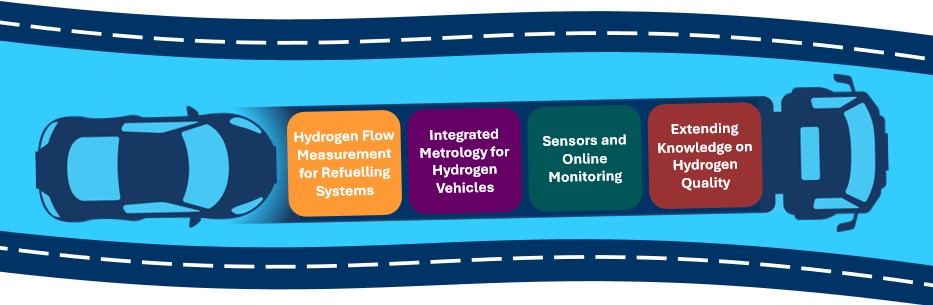
In order to realise the project, it is divided into six individual work packages (WPs). Apart from the obligatory two WPs of “Management & Coordination” and “Creating Impact”, the four central WPs to the project are; “Hydrogen Flow Measurement for Refuelling Systems”, “Integrated Metrology for Hydrogen Vehicles”, “Sensors and Online Monitoring” and “Extending Knowledge on Hydrogen Quality”. Together, these work packages will deliver new metrology infrastructure, validated procedures, and good practice guides to support the rapid deployment of hydrogen refuelling stations in Europe. They will enable accurate billing, improved safety, and reliable fuel quality control, which are critical for the operation of hydrogen refuelling stations.
WP1 Hydrogen Flow Measurement for Refuelling Systems

This work package aims to strengthen the metrological framework for testing and verifying hydrogen refuelling stations (HRS) at very high flow rates, up to 18 kg/min for heavy-duty vehicles. The approach is based on a traceability chain using primary and secondary hydrogen standards, supported by surrogate fluids for calibrating secondary standards and testing flow meters. This will cover both 35 MPa and 70 MPa applications and demonstrate its potential for larger vehicles such as ships, trains, and aircraft. Uncertainties linked to surrogate fluid calibration will also be assessed.

  • Develop and validate methods using secondary standards for refuelling at up to 18 kg/min, comparing calibration data from hydrogen and surrogate fluids.
    • focuses on developing and validating metrological infrastructure for testing high-flow hydrogen refuelling systems for heavy-duty vehicles, up to 18 kg/min. The use of secondary standards (master meter skids) will be extended to these flow rates, with a nominal flow rate of 12 kg/min. At least two master meter skid designs will be created to support flows up to 18 kg/min.
  • Calibrate commonly used HRS flow meters with hydrogen and surrogate fluids and quantify uncertainty when surrogate fluids replace hydrogen.
    • Enable the calibration of coriolis flow meters commonly used in Hydrogen Refuelling Stations with surrogate fluids and determine the associated uncertainty. This approach will streamline type approval processes that rely on performance testing with surrogate fluids. Since HRS meters operate under different temperature conditions than the master meters, their calibration data cannot be directly compared. Therefore, a separate set of calibration data will be generated specifically for Hydrogen Refuelling Station coriolis meters using surrogate fluids.
  • Demonstrate the use of secondary standards for large-scale applications and define achievable uncertainty levels.
    • demonstrate the use of secondary standards (master meters) for the higher hydrogen flow rates required by large vehicles such as ships, trains, and aircraft, and estimate achievable uncertainty. The initial approach is to assess whether the master meter calibration curve can be extended to flows up to 18 kg/min. Additionally, a bootstrapping method using multiple master meters in parallel will be explored.
      •  
WP2 Hydrogen Flow Measurement for Refuelling Systems

This work package aims to design, build, and validate mobile verification units for hydrogen refuelling stations (HRS), traceable to SI units. These mobile verification units will combine the secondary flow standards and the validated hydrogen sampling systems in a single site visit, enabling dispenser accuracy and hydrogen quality checks. The design will support both light- and heavy-duty Hydrogen Refuelling Stations, with at least one unit suitable for both. Key objectives include compliance with OIML R139 and EN 17124, covering new SAE J2601-5 requirements, and reducing sampling and verification time by half while maintaining performance.

  • Design two mobile integrated HRS verification units.
    • The goal is to reduce labour requirements while maintaining operability and improving environmental impact, with expected labour savings specified. Accuracy of flow measurement, hydrogen sampling, and safety will be prioritized. Where possible, the units will be modular, comprising a traceable secondary flow standard and a validated hydrogen sampling system.
  • Build the units and develop test procedures.
    • This task will produce detailed designs and construction for two mobile integrated HRS verification units based on the preliminary concepts. Separate test procedures will be developed for both modules.
  • Validate the units for accuracy and reliability.


This task will validate the two mobile integrated Hydrogen Refuelling Station verification units. Testing will be carried out under both laboratory and real-world conditions, at hydrogen flow rates up to 18 kg/min and pressures up to 87.5 MPa. Potential interference between modules during operation will also be assessed.

WP3 Sensors and Online Monitoring 

This work package advance knowledge and provide technical evidence on sensors and analytical devices to optimize Hydrogen Refuelling Station Management. It focuses on leak detection sensors and analytical tools for hydrogen quality assessment, reducing operational costs and increasing stakeholder confidence. While previous projects have addressed aspects of these technologies, gaps remain—such as detecting low hydrogen concentrations and developing low-cost integrated sensors for N₂, O₂, and H₂O. Emerging technologies will be evaluated on reliable test benches, and methods will be developed to ensure representative measurements and harmonized practices. Special attention will be given to comparing laboratory and field calibration.

  • Study sensors for hydrogen leak detection and safety.
    • Although safety regulations and technologies for hydrogen leak detection are well established, monitoring low-concentration leaks for environmental and greenhouse gas impacts remains a gap. Even small leaks in complex HRS structures can lead to hydrogen accumulation in blind spots or under roofs. Sensors must also be safe for use in explosive atmospheres (zones 0 or 1). This task will identify limitations in current commercial technologies for detecting low hydrogen concentrations and evaluate new sensor solutions with input from industry. Synergies with ongoing European projects on hydrogen’s greenhouse effect will be explored to maximize impact.
  • Validate integrated sensors and analysers for H₂O, N₂, and O₂ in the field.
    • This task aims to develop integrated sensors and analysers for common hydrogen fuel contaminants (e.g., N₂, H₂O, O₂) and assess their performance under both laboratory and HRS conditions, including high flow (up to 60 g/s) and high pressure (up to 35 MPa). It will advance previous lab-based work to field testing at HRS, focusing on inter-comparison of sensors and analysers under real operating conditions. The outcome will support new guidance for sensor validation in the field.
  • Develop methods and standards for onsite sensor calibration.
    • This task aims to develop methodologies and standards for onsite calibration of hydrogen quality sensors. These standards will be applied in the field to validate sensors detecting at least three key contaminants: water vapour, oxygen, and nitrogen. Calibration procedures will use reference materials based on hydrogen cylinders with defined impurity levels. Results from onsite and laboratory calibrations will be compared to assess feasibility and consistency. Insights from this work will support a good practice guide for onsite sensor calibration.
  • Investigate novel sensor technologies for hydrogen applications.


This task aims to identify and qualify next-generation hydrogen quality sensors and techniques (typically low TRL) capable of detecting new impurities identified in during the project. These sensors will be characterized under laboratory conditions using new protocols and evaluated for their added value in online impurity analysis compared to commercial solutions. Key performance indicators such as cost-effectiveness, impurity range, and detection limits (LODs) will be assessed.

WP4 Extending knowledge on hydrogen quality

Mapping future hydrogen fuel contaminants is critical to prevent failures that could jeopardize the sector. Rapid HRS expansion and supply chain diversification will introduce new sources and unexpected impurities, potentially impacting fuel cell vehicles. To avoid costly trial-and-error, this work package will identify these contaminants and provide reliable datasets to support the hydrogen economy rollout. It will use calibrated analysers to examine over 45 real-world samples from production, transport, and storage (e.g., gas grids, ammonia cracking, LOHC, underground storage). The focus is on contaminants beyond EN 17124 and ISO 14687 specifications, requiring advanced metrology expertise.

  • State of the art of hydrogen quality and the development of the probability of contaminant occurrence
    • This task reviews the current state of hydrogen quality, focusing on novel and emerging transport infrastructure. It will analyze literature and key processes such as storage, production, e-fuels, hydrogen carriers, compressors, and Hydrogen Refuelling Station components. Existing projects (e.g., HypSter, DGMK884-1) and manufacturers will be consulted to identify gaps and needs for deploying a reliable supply chain. The outcome will be a list of potential contaminants across 15 emerging supply chain elements, providing valuable new insights for the hydrogen industry and low-carbon transport.
  • New measurement methodology to extend knowledge on hydrogen quality
    • This task aims to extend knowledge on hydrogen quality by developing or adapting analytical methods and metrological processes, including reference materials, method validation, and sampling techniques for the new contaminants identified in the project. Based on research institute expertise, the most suitable methods will be selected and tested with emphasis on accuracy, detection limits, and traceability. For complex contaminants, an alternative tracer-based approach will be explored. Recommendations for further metrological development will be provided.
  • Hydrogen sampling and analysis campaign
    • This task will deliver real-world hydrogen quality data from at least 15 emerging supply chain elements identified in the project. Sampling and analysis will follow the methodologies defined, covering 24 sites and more than 45 samples. Each sample will be tested for 2–10 compounds, resulting in 80–400 quantitative measurements—the largest investigation of hydrogen quality for new supply chain elements to date. Using traceable, accurate methods will provide evidence on the likelihood of new contaminants and inform future metrological requirements. The work builds on recent projects (HyQuality Europe, MetroHyVe 2, Met4H2, MetHyTrucks) and will deliver the first comprehensive dataset for hydrogen quality across the new supply chain.
  • Evaluation of the new contaminants identified and their potential impact on hydrogen fuel cell systems
    • This task will combine knowledge of potential contaminants with analytical results from the project to deliver robust insights into future hydrogen fuel quality control. Contaminants with high occurrence probability or risk will be tested at fuel cell level to assess their impact on system performance. Findings will be shared with standardization bodies, industry, metrology institutes, and analytical labs to ensure an appropriate measurement framework for the evolving hydrogen supply chain.
WP5 Creating Impact

This work package aims to ensure that the results of the MetroHyVe3 project have a lasting impact beyond the project duration and are effectively integrated into the European hydrogen infrastructure. The focus is on the strategic dissemination of project outcomes, engaging relevant stakeholders, and supporting standardization processes. It is not only about communication but also about harmonizing measurement methods and creating a foundation for their international recognition. By building a community of industry partners, standardization bodies, and research institutions, knowledge transfer will be promoted and the acceptance of new technologies increased. Another key aspect is monitoring the long-term impact of the project results and deriving recommendations for further implementation.

  • Develop and maintain communication materials
    • Create and update the project website, social media posts, and newsletters to keep stakeholders informed and engaged.
  • Organize workshops, conferences, and demonstration events
    • Plan and host events to showcase project results and encourage dialogue with industry and research communities.
  • Prepare guidelines and best-practice documents for industry
    • Draft clear, practical documents that help companies implement the developed measurement methods effectively.
  • Support standardization processes and coordinate with European and international bodies
    • Work with standards organizations to integrate project outcomes into official norms and ensure global alignment.
  • Monitor impact and provide recommendations for further implementation
    •  Track how project results are being used and propose actions to maximize their long-term benefits.
WP6 Management & Coordination

This work package forms the organizational backbone of the project and ensures that all technical work packages collaborate efficiently. It includes coordinating all activities, monitoring timelines, budgets, and quality, and ensuring compliance with administrative and legal requirements. A key element is establishing clear communication structures within the consortium to guarantee smooth information exchange. Furthermore, the work package covers the preparation of regular progress and financial reports for the funding authorities and the organization of governance meetings. Another major focus is risk management to identify potential project risks early and implement measures to mitigate them.
  • Organize general assemblies and steering committee meetings
    • Schedule and manage key governance meetings to align partners and make strategic decisions.
  • Coordinate the governance structure and involve the advisory board
    •  Maintain clear roles and responsibilities and ensure expert input through the advisory board.
  • Prepare reports for EU funding authorities
    • Compile progress and financial reports that meet all requirements for transparency and accountability.
  • Develop and implement a risk management plan
    • Identify potential risks early and define mitigation strategies to keep the project on track.
  • Ensure quality assurance and documentation of all project results
    • Implement processes to verify the accuracy and completeness of deliverables and maintain proper records.