
Upcoming Event: ELEVATEcee Working Conference #1, Vienna, 24 March 2026, Registration open
The first Working Conference#1 of the EU-funded project ELEVATEcee will take place
on the 24 March 2026 in Vienna,
hosted by Wien Energie and WIVA P&G.
The event will bring together key stakeholders of the quadruple helix from Austria, Slovakia, and Hungary to connect, exhange ideas, and advance cross-border hydrogen and green molecule projects in the region.
The registration is now open:

Present your project in a project pitch on the Working Conference#1 by registering with the pitch preparation pack.
About ELEVATEcee
Launched in October 2025, ELEVATEcee unites national and regional stakeholders from the quadruple helix to identify and develop complete hydrogen value chains – from energy generation and hydrogen production to transport, storage, and end-use applications.
In the context of the project, 3 different Working Conferences will be organised to present project results and enable hands-on collaboration through breakout sessions, directly contributing to the project’s objectives of developing joint value chains, investment-ready projects, and cross-border business creation.
About the Working Conference #1
The working conference focuses on two objectives:
1. Value Chain Identification and Matchmaking, including pitch sessions,
interactive matchmaking, and breakout workshops .
– Industry, SMEs; Researchers and Uptakers
2. Kick-off the Skills Development in policy, technology and financing.
– Authorities, Development Agencies, Funding Agencies and Investors
Following the introduction and the agenda item “Potential value chains in cross-border regions” and the project pitch sessions in the morning, the conference will split into two streams at 2 p.m.: the project partnering workshops (with participants from point 1) and the cross-regional strategy workshop (with participants from point 2).
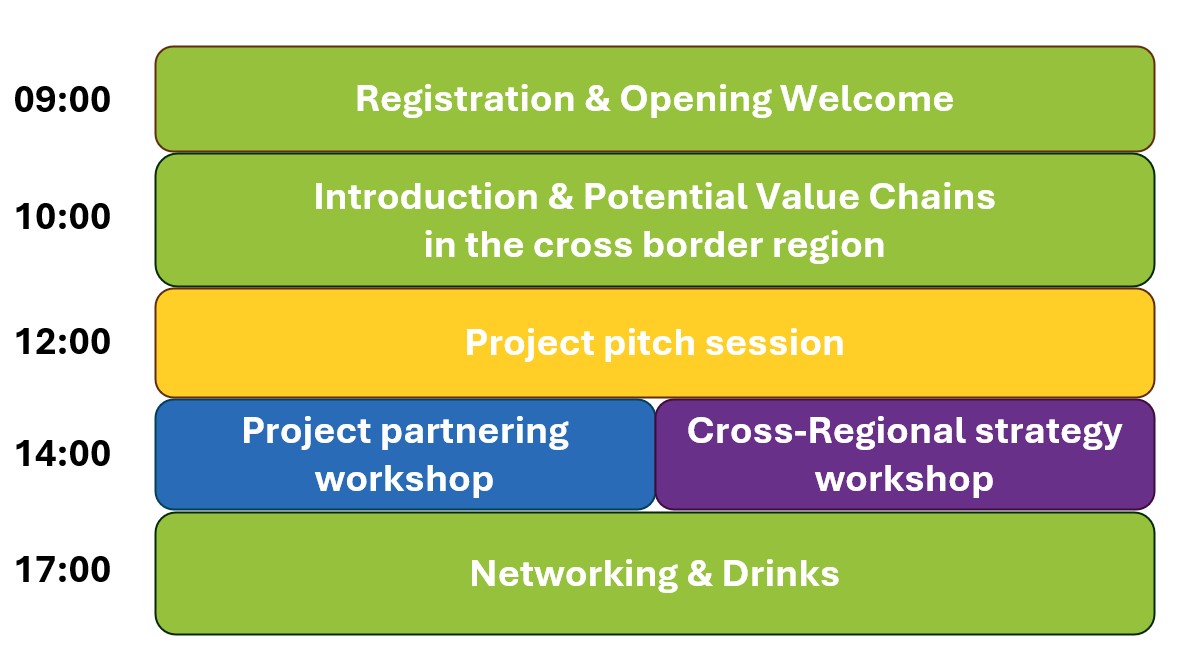
Conference Details
Date: 24 March 2026, 09:00–18:30, Vienna Austria Language: English
Detailed Information and Background
Across Austria, Slovakia and Hungary, hydrogen and green molecules projects are progressing from early concepts to pilots, scale-ups and infrastructure planning. Yet, cross-border visibility of concrete initiatives and structured partnering formats remain limited. ELEVATEcee Working Conference #1 addresses this gap by bringing project owners and relevant counterparts together in a focused working setting.
Working Conference #1 is designed to advance existing project concepts—not only to generate new ideas. The format supports consortium formation, partner matching and clear next-step definition, including pathways towards funding and financing readiness within the ELEVATEcee project pipeline.
Why “Working Conference #1”?
ElevateCEE implements three Working Conferences within the next 12 months (Working Conferences #2 in Györ and #3: location tba.).
Working Conference #1
Conference in Vienna (Vienna) focuses on building consortia around pitched projects and defining collaboration needs.
Working Conference #2
Conference in Györ strengthens and expands these consortia (and can also form new ones), adding missing competences and sharpening project structures.
Working Conference #3
This Conference is designed to work with more mature project concepts, integrating investor and financier feedback and preparing the next maturity step.
In addition, ELEVATEcee engages a cross-border Investors Panel through a series of exchanges to provide structured feedback on
bankability, financing logic and risk topics, and to support the development of fundable and financeable project propositions.
Who should participate?
Working Conference #1 is open to stakeholders across the quadruple helix, including:
- Project owners (start-ups, SMEs, industrial companies, research organisations) with project concepts seeking partners and/or financing pathways
- Industrial offtakers, technology providers, infrastructure operators, utilities, cluster organisations
- Public authorities, funding bodies, energy agencies and financing actors (as relevant for partnering and investment-readiness discussions)
Scope: Technologies and value chains
Working Conference #1 covers hydrogen and green molecules value chains across production, infrastructure and end-use, including enabling carbon streams and CCUS interfaces. Topics include, for example:
- Renewable hydrogen production and integration (incl. flexibility options and sector coupling concepts such as use of oxygen and waste heat)
- Hydrogen and derivative infrastructure: pipelines/repurposing, hubs, import/export corridors; storage concepts (incl. geological and other storage approaches)
- Industrial applications (chemicals, refineries, steel, glass/ceramics, and pulp & paper as a potential source of biogenic CO₂)
- Mobility applications (e.g. heavy-duty transport, buses, rail, logistics)
- Green molecules and climate-neutral carbon value chains (e-methanol, e-ammonia, green olefins, SAF; biogenic CO₂, DAC and circular carbon streams)
- Cross-cutting solutions (digital planning/optimisation, market design, business models; scale-up and demonstration projects).
Scope: Skills Development in Policy, Technology and Financing
The first step is the assessment of the status quo. Existing national and regional hydrogen action plans and relevant strategic documents are reviewed. The focus is on frameworks, including production, storage, distribution, and end-use.
For each country and for the EU, goals, timelines, and initiatives are identified. The analysis follows a PESTLE-oriented approach. The results are structured into the following 6 dimensions:
- Policy and Regulation
- Economics and Social
- Technology and Ecology
For each dimension, barriers and opportunities are identified. These findings form the basis for stakeholder review in the first workshop.
In the first workshop the identified barriers and opportunities are presented to stakeholders. Each dimension is addressed sequentially. For a given dimension, each participating country/EU present their results for five minutes per country/EU, using one slide with a table outlining barriers and opportunities. This is followed by a discussion with stakeholders. Only then does the process move on to the next dimension. The same format is applied consistently in all workshops. Stakeholders are invited to contribute insights. Discussions focus on opportunities, barriers, assumptions and risks.